Hanwoojeong Myeongdong Korean BBQ: A Review on Premium 1++ Hanwoo Korean BBQ Experience in Myeongdong, Seoul
When people search for Korean BBQ in Seoul, the options can become overwhelming very quickly. There are casual neighborhood barbecue restaurants, all-you-can-eat concepts, long-established galbi restaurants and increasingly polished dining rooms built around Korea’s most prized native beef: Hanwoo.
During a recent visit to Myeongdong, I tried Hanwoojeong, a premium Korean BBQ restaurant specializing in 1++ Hanwoo beef. What immediately separated the experience from a standard Korean barbecue meal was that Hanwoojeong did not simply place expensive beef on the table and expect the meat to speak for itself. The restaurant had clearly thought about the complete dining experience, from the hanok-inspired interior and traditional presentation of the meat to real charcoal grilling, multilingual explanations and an unusually extensive collection of Korean traditional alcohol, wine and whisky.
There were also several details that I had not seen combined in quite this way elsewhere in Seoul. The beef arrived on a platter designed like the roof of a traditional Korean hanok. Before eating, we could actually see a large section of beef being broken down and prepared inside the restaurant, making the freshness of the meat much more tangible than simply reading a grade on a menu. The table was covered with a much broader selection of banchan and sauces than I expected from a premium beef restaurant, and staff remained at the table to grill the meat and explain how different cuts could be paired with sauces and accompaniments.
For travelers who want to try high-quality Hanwoo in Seoul rather than simply check Korean BBQ off their itinerary, Hanwoojeong offers a noticeably more curated experience.
Today’s Stop! — Hanwoojeong Korean BBQ
Address : Myeongdong 3-gil 44, 3rd Floor
Instagram : @hanwoojeong
Where Is Hanwoojeong?
Hanwoojeong is located in Myeongdong, Seoul, one of the easiest neighborhoods for international visitors to reach and one of the areas where many travelers naturally spend time during their first trip to Korea.
That location matters more than it might initially seem. Some of Seoul's most interesting meat restaurants are located far away from the main tourist districts, which can make a premium dinner surprisingly inconvenient if you only have a few days in the city. Hanwoojeong allows visitors to combine a Hanwoo dinner with sightseeing and shopping around central Seoul without dedicating half the evening to transportation.
The restaurant itself is above street level, and once inside, the atmosphere feels much more restrained than the busy streets of Myeongdong below.
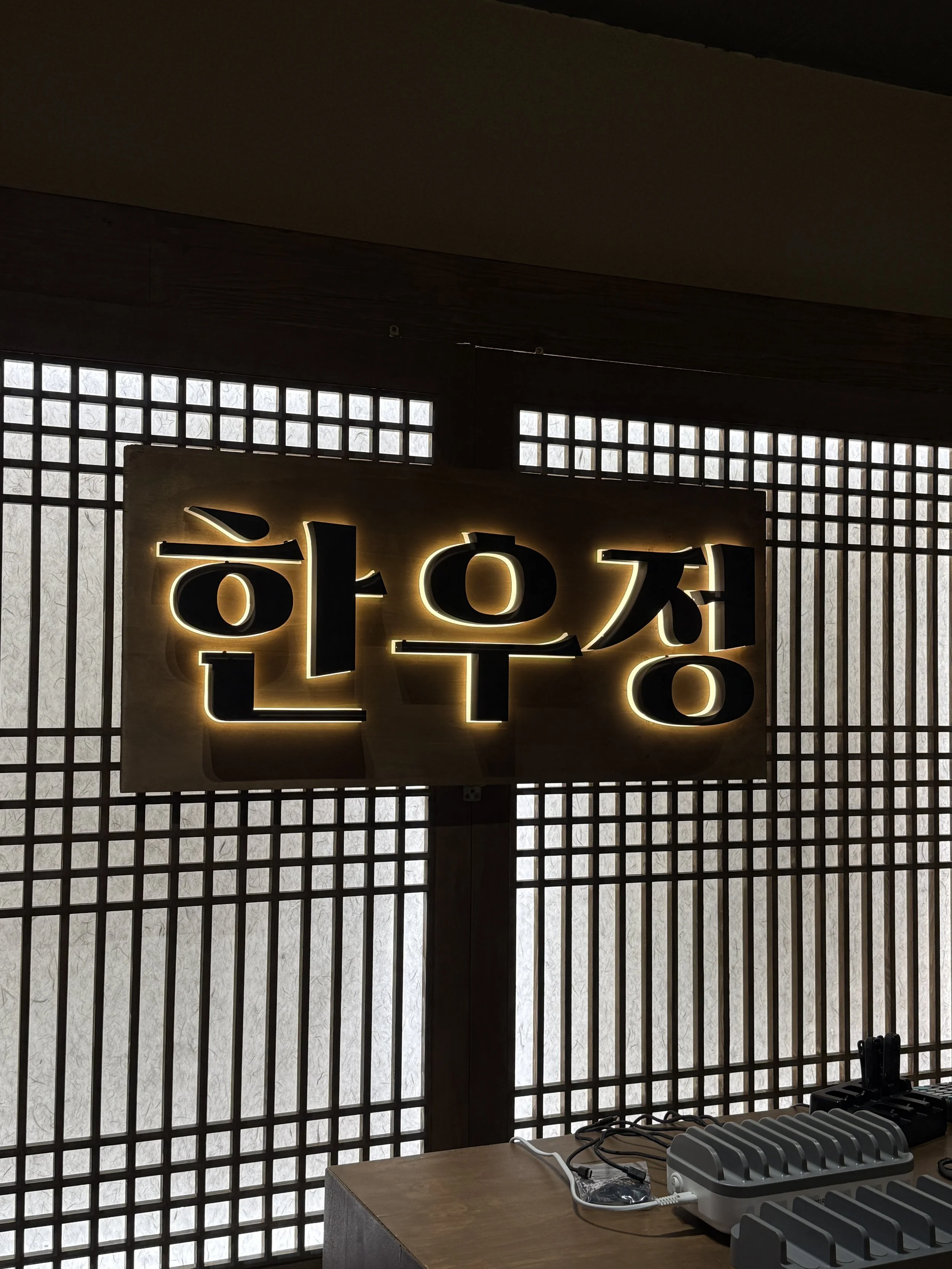
The First Impression: Modern Korean Design With a Hanok Influence
The first thing I noticed about Hanwoojeong was that it did not attempt to create luxury through excessive decoration.
Instead, the restaurant takes visual cues from traditional Korean architecture. Dark wood, latticework, exposed structural details and warm lighting give the room a subtle hanok-inspired atmosphere without making the space feel like a historical theme restaurant.
The illuminated 한우정 sign against the traditional lattice background is one of the clearest examples of the restaurant's design direction. There is a deliberate contrast between the old and the new: traditional Korean architectural references are paired with modern grills, contemporary tableware and a polished dining-room setup.
That visual identity continues at the table.
Even the placemat introduces the meaning behind the restaurant's name. “Hanwoo” refers to Korea's native beef, while “Jeong” evokes warmth, connection and the sense of sharing that plays such an important role in Korean dining culture.
It is a small touch, but it gives international guests some cultural context before the meal begins.
For a restaurant built around premium Korean beef, that connection to Korean identity feels considerably more appropriate than creating another generic steakhouse-style interior.
Seeing the Hanwoo Being Prepared Changed the Experience
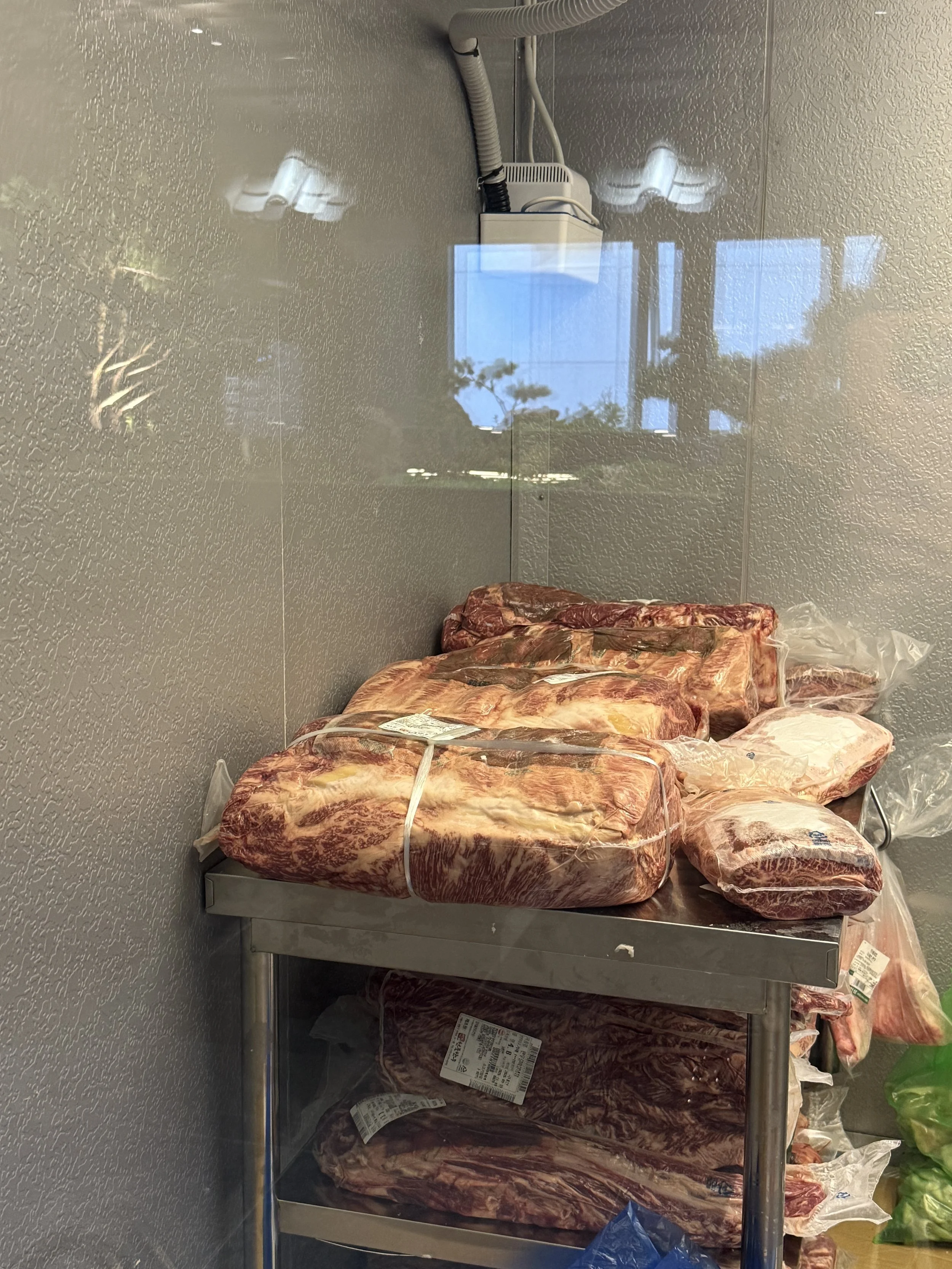
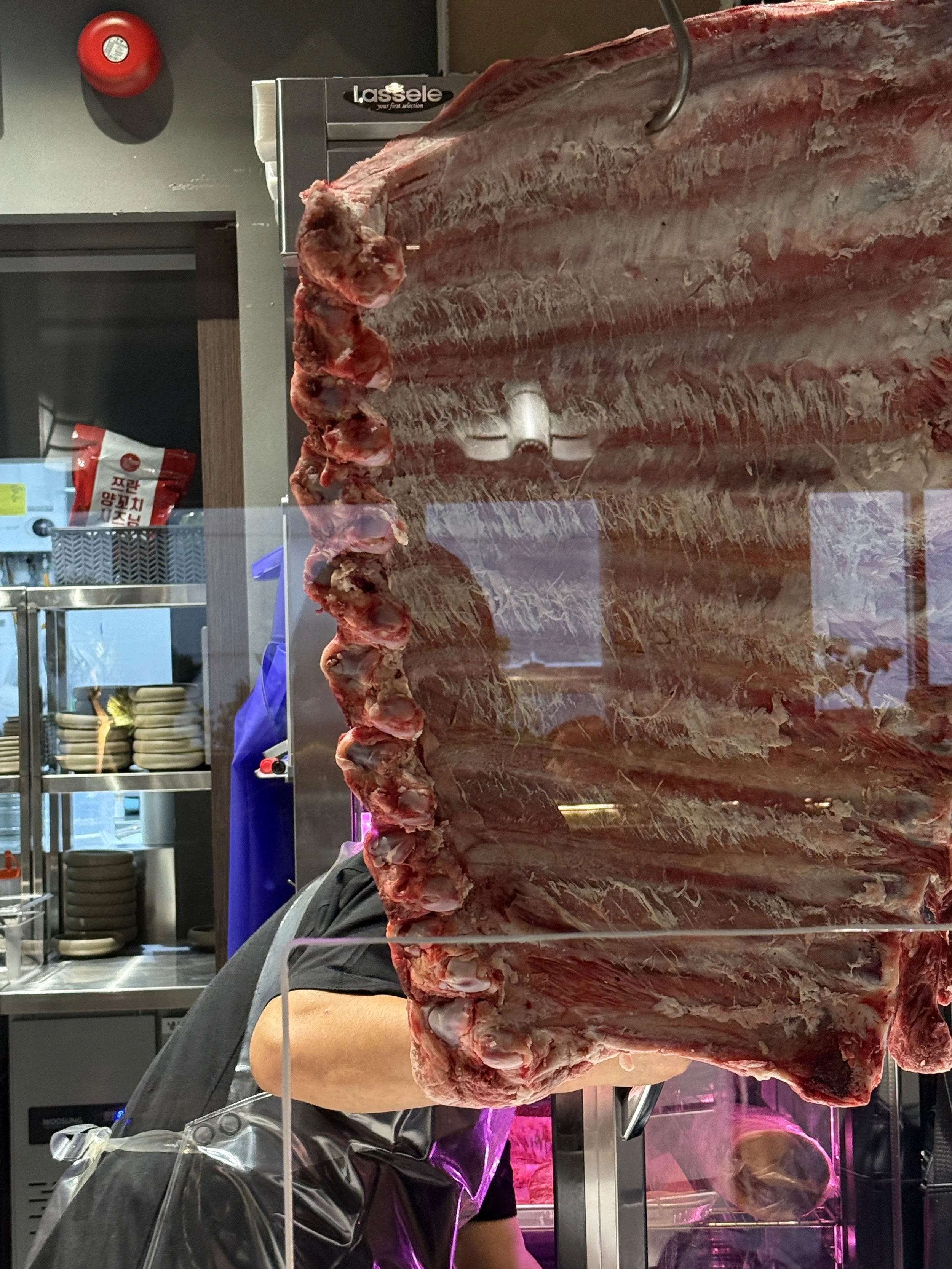
One of the most memorable moments came before the beef even reached our table.
Inside the restaurant, we could see a large section of beef being handled and cut down for service.
This is the kind of detail that matters when a restaurant is positioning itself around premium beef. Many restaurants talk about freshness, sourcing and quality, but as a customer, you rarely see anything beyond neatly sliced meat arriving from the kitchen.
Here, the preparation process was much more visible.
Seeing the rib section being broken down gave us a better sense that the restaurant was actually working with larger cuts of Hanwoo rather than simply opening trays of pre-portioned meat in the kitchen.
For diners paying premium prices for 1++ Hanwoo, this kind of transparency can add confidence to the meal.
It also gives visitors a much stronger visual understanding of what they are eating. Korean beef terminology can be confusing for travelers because cuts are sometimes translated differently across restaurants. Seeing the original section of beef makes the experience feel more connected to the actual product rather than simply to menu terminology.
What Is 1++ Hanwoo?
For anyone unfamiliar with Korean beef, Hanwoo is Korea's native cattle breed and occupies a position in Korean food culture that is somewhat comparable to the reputation of Wagyu in Japan.
Within Korea, beef is graded according to several quality factors, and 1++ represents the highest Korean beef quality grade.
That does not mean every piece of 1++ beef tastes exactly the same. The breed, individual animal, cut, marbling distribution, aging, preparation and grilling technique all affect the final experience.
What 1++ generally signals to diners is that they are entering the premium end of the Korean beef market.
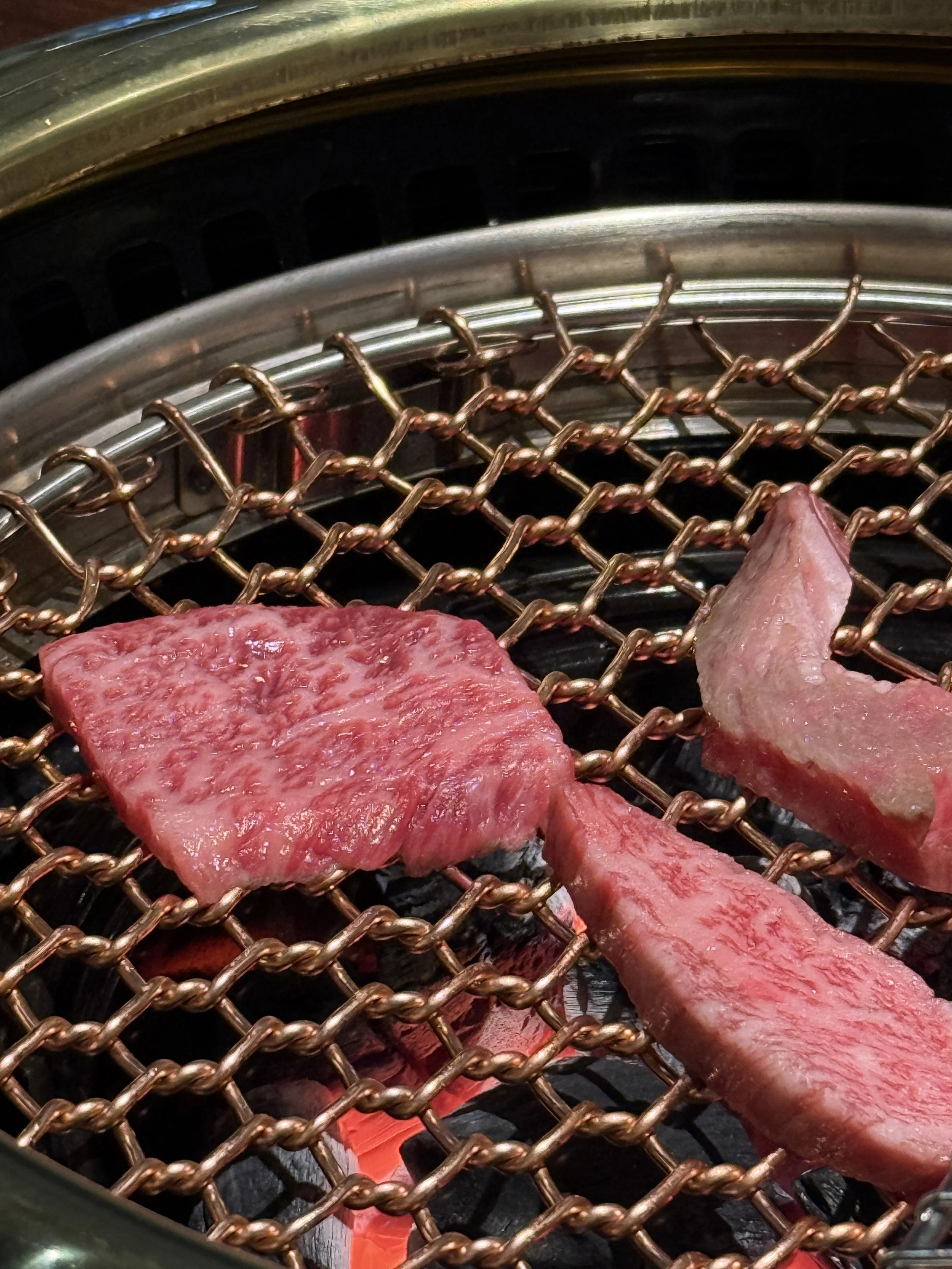
At Hanwoojeong, the visual quality of the meat was immediately apparent. The cuts had dense but well-distributed marbling, with thin veins of fat running through the meat rather than simply forming large external sections.
As the beef cooked over charcoal, that fat slowly rendered through the meat, giving it the richness associated with high-grade Hanwoo without making every bite feel overwhelmingly fatty.
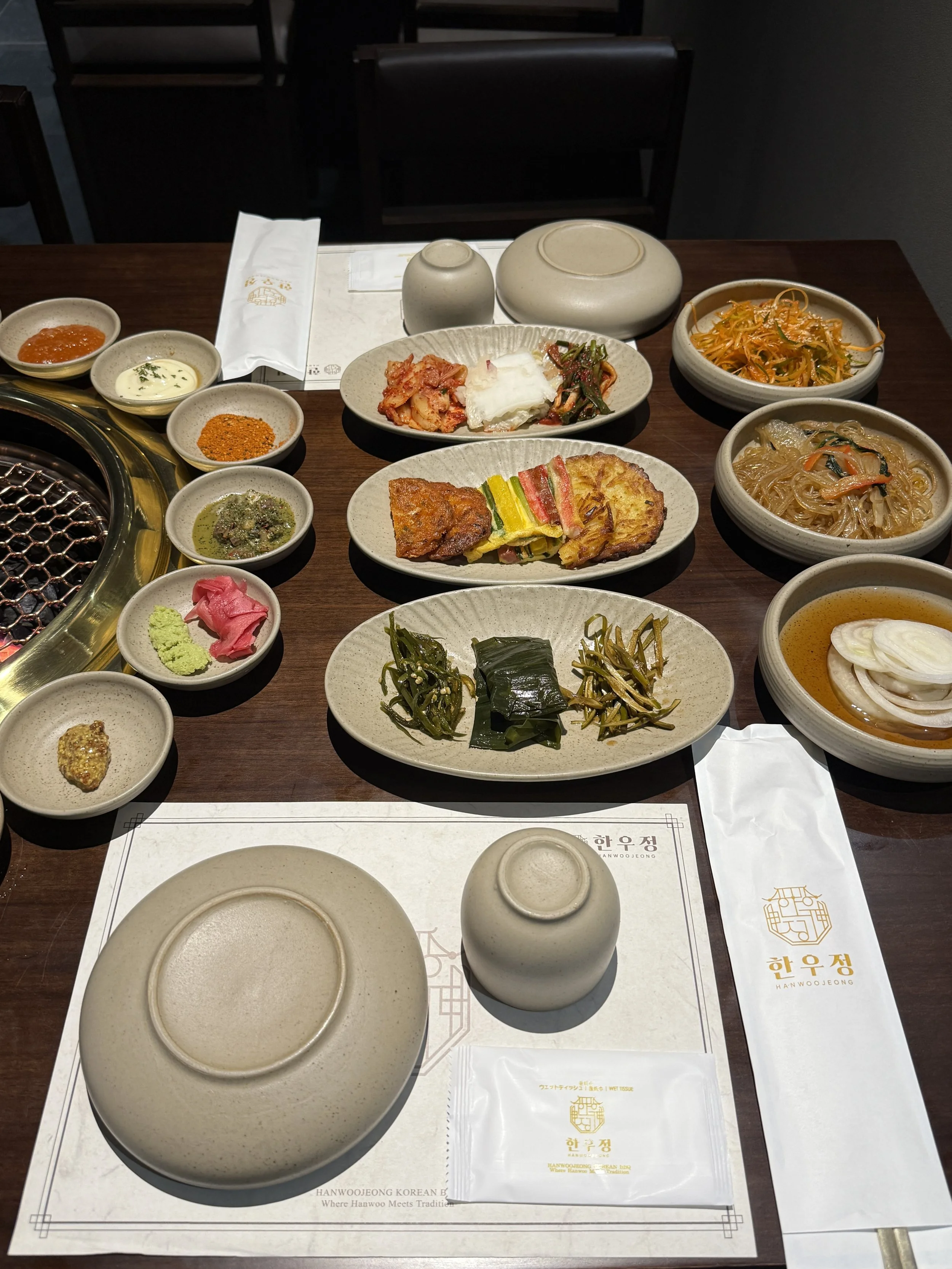
A Serious Banchan Spread Before the Meat Even Starts
Premium Korean beef restaurants sometimes take a surprisingly minimalist approach to side dishes. Hanwoojeong goes in the opposite direction.
Our table quickly filled with banchan, sauces, dipping seasonings and cooked dishes.
There were the expected Korean accompaniments such as kimchi and seasoned vegetables, but the selection went considerably further.
We were served japchae, the classic Korean glass noodle dish, along with several types of jeon.
The jeon selection included potato jeon, kimchi jeon and kkochi-jeon, or skewered Korean-style jeon.
That immediately made the meal feel more generous than the side-dish selection at many premium meat restaurants.
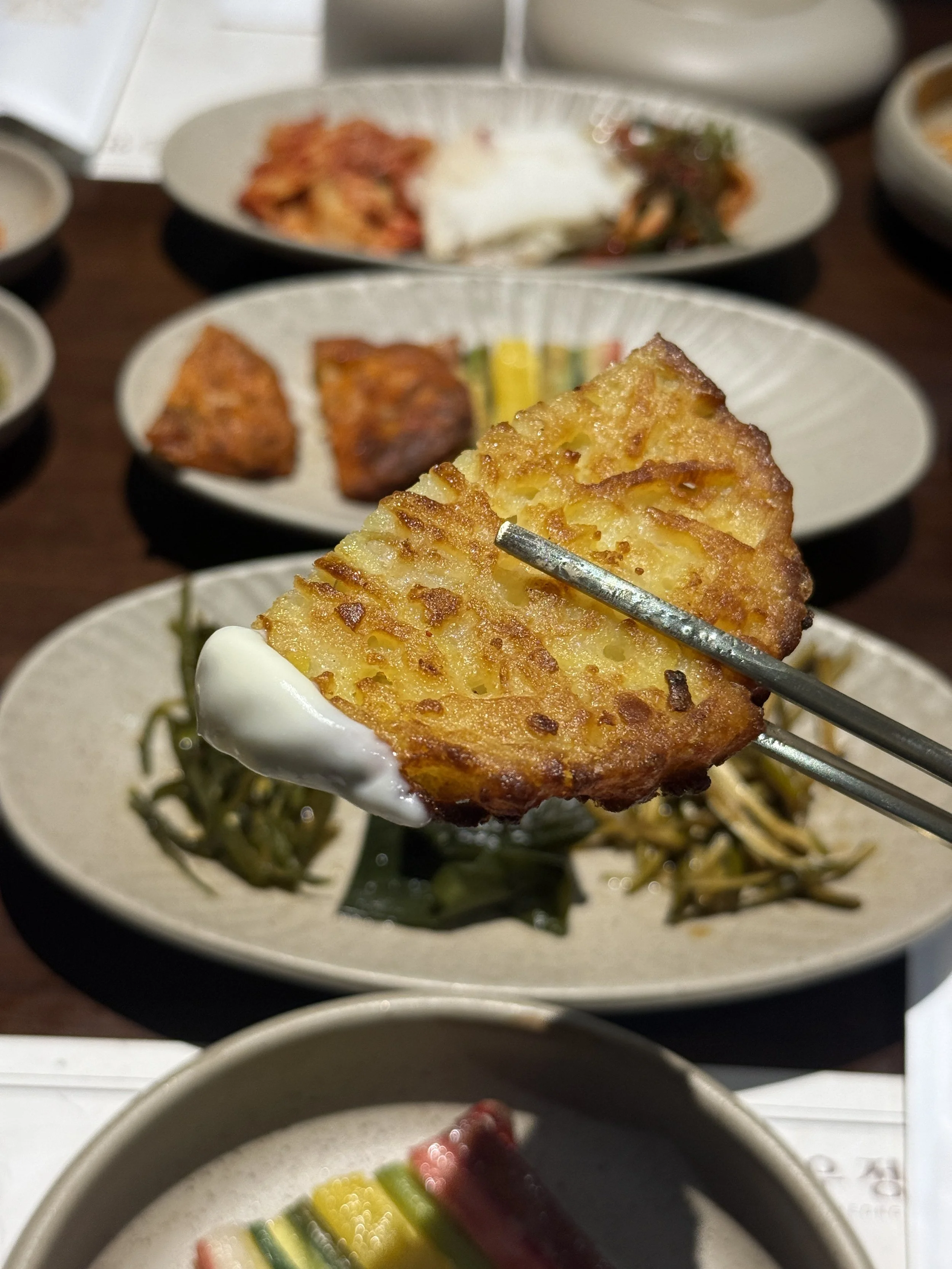
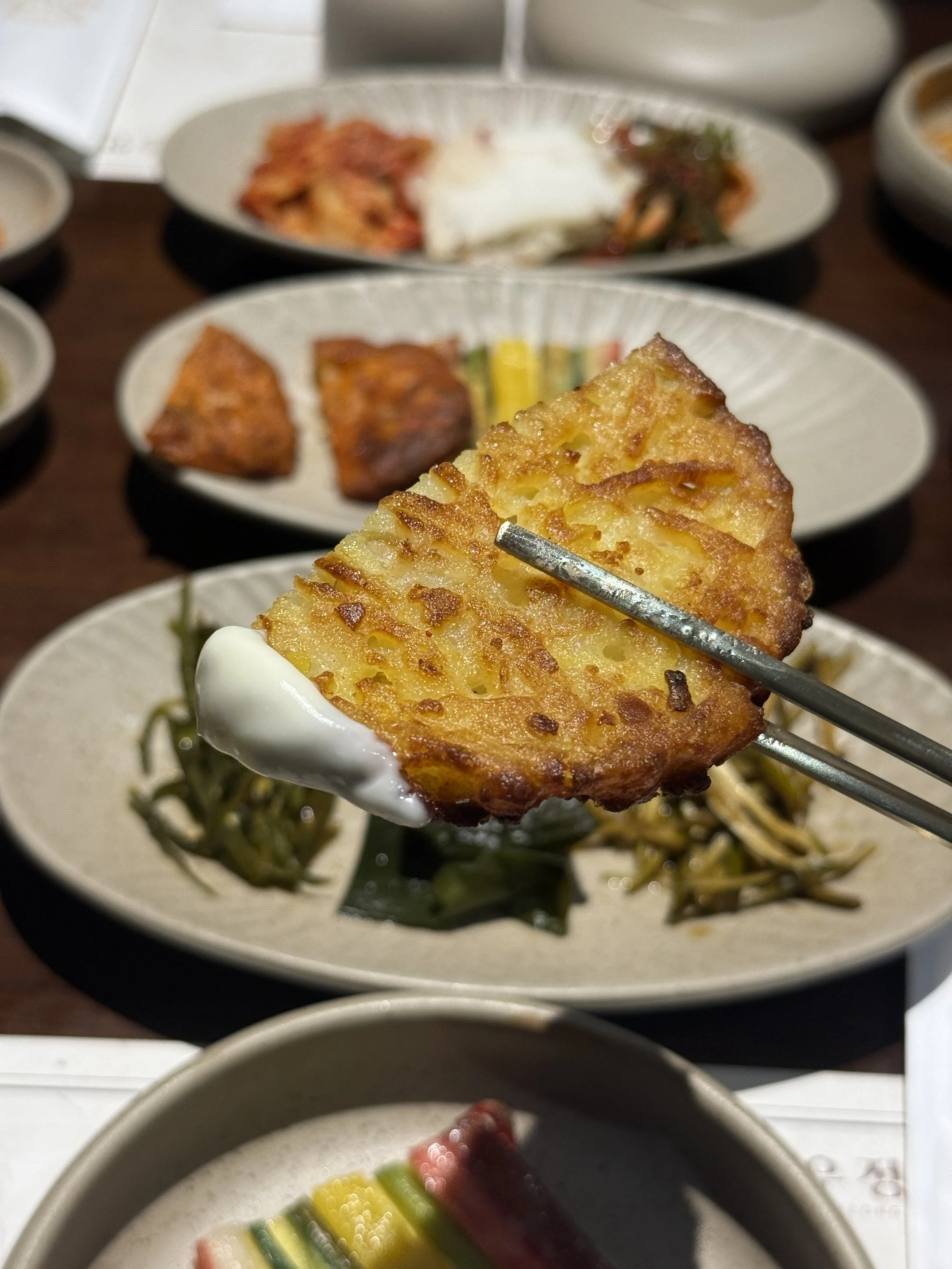
The potato pancake became one of the unexpected highlights of the meal. It was crisp and deeply browned on the outside while remaining soft inside, and one of the restaurant's sauces turned out to be an excellent accompaniment.
More on that shortly.
Nine Sauces and Seasonings Give the Beef Completely Different Characters
Another feature that stood out was the number of sauces served with the meat.
There were nine different sauces and seasonings on the table.
Rather than covering premium beef in one heavy sauce, Hanwoojeong gives diners several options that highlight different aspects of the meat.
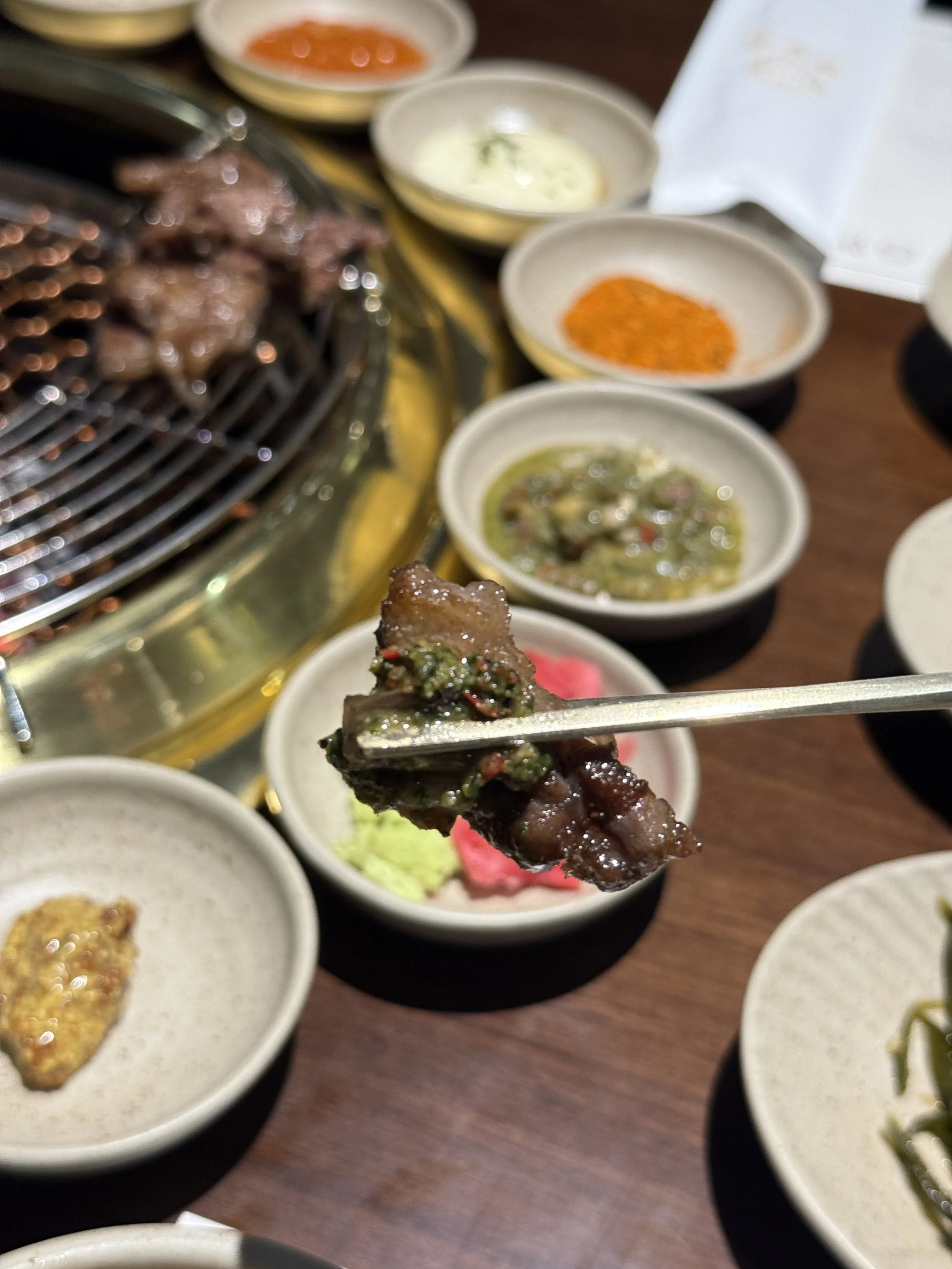
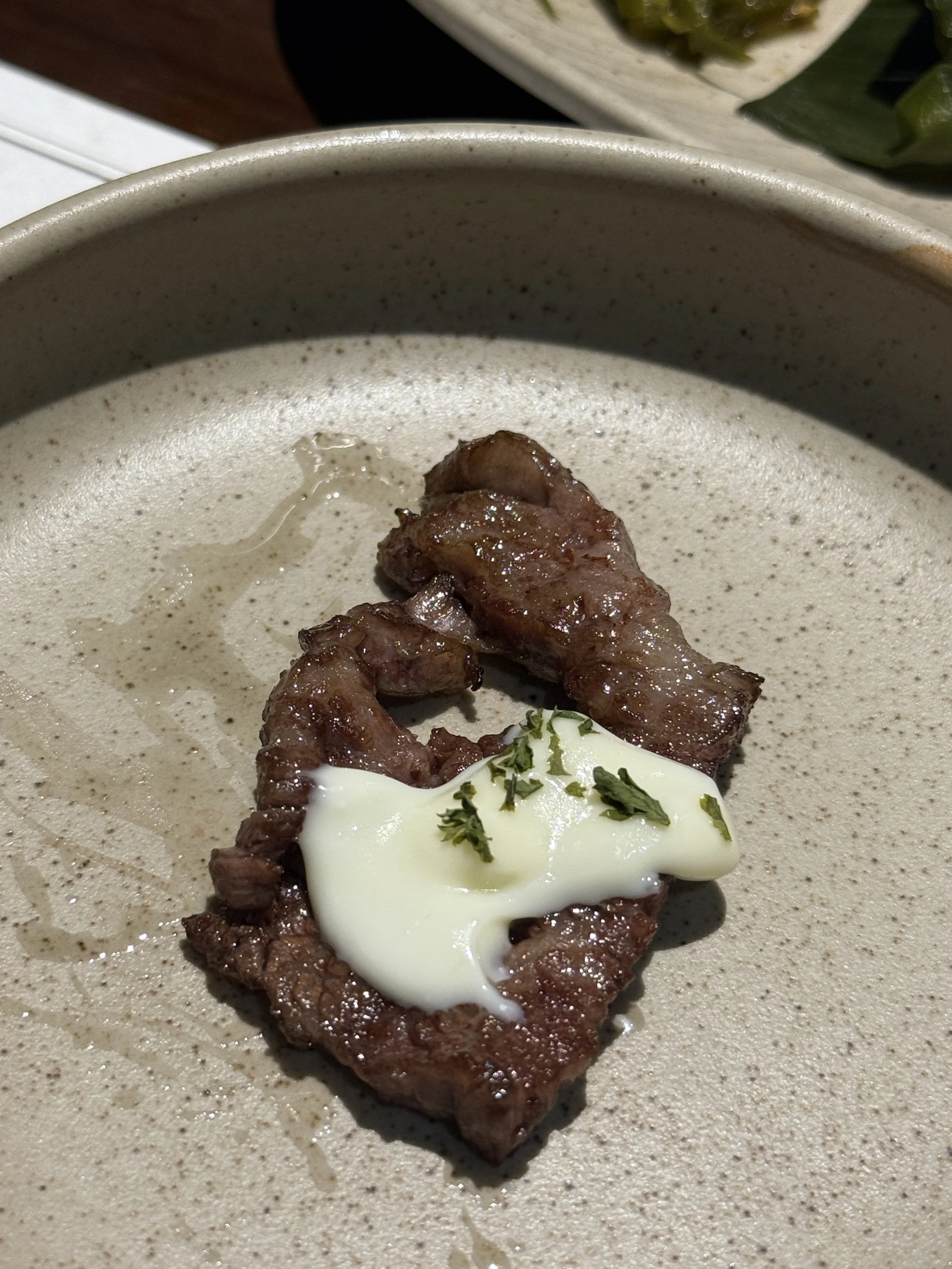
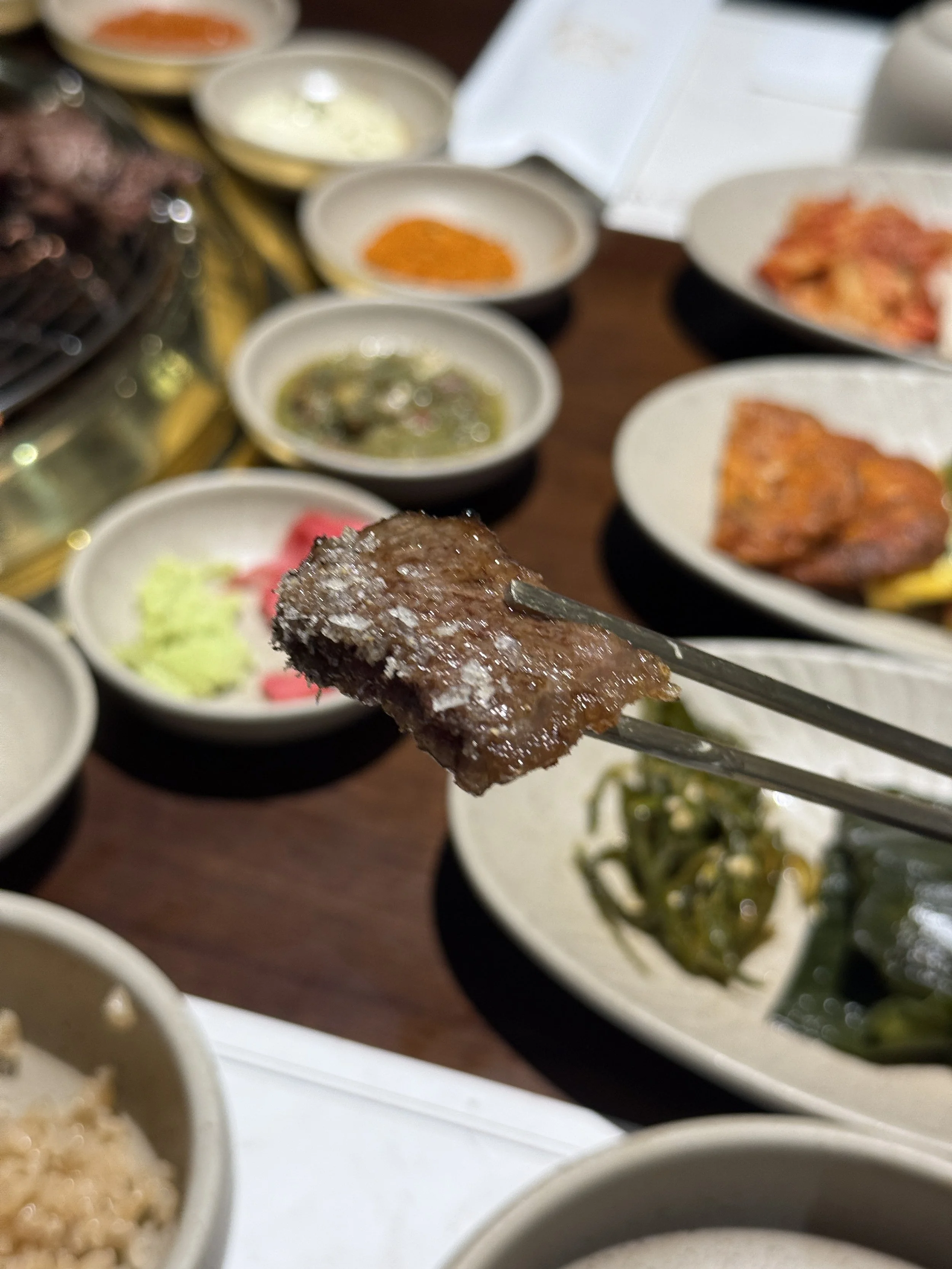
The selection included straightforward salt for people who want to taste the beef with minimal interference, alongside stronger and more aromatic options such as chimichurri and truffle mayonnaise.
There was also wasabi and pickled ginger available for pairing.
This makes the meal particularly good for groups because different diners inevitably prefer different levels of seasoning with heavily marbled beef.
Personally, I found that the best approach was to begin with salt and taste the beef as simply as possible before moving toward the richer sauces.
The chimichurri added acidity and herbs that cut through the richness of the Hanwoo particularly well, while the wasabi created a sharper contrast that worked especially nicely with fattier cuts.
The truffle mayonnaise was much richer.
Interestingly, I enjoyed it even more with the potato pancake than with the beef.
The crisp potato jeon dipped into the creamy truffle sauce was one of those combinations that sounded fairly simple but became extremely difficult to stop eating once we tried it.
Real Charcoal Makes a Noticeable Difference
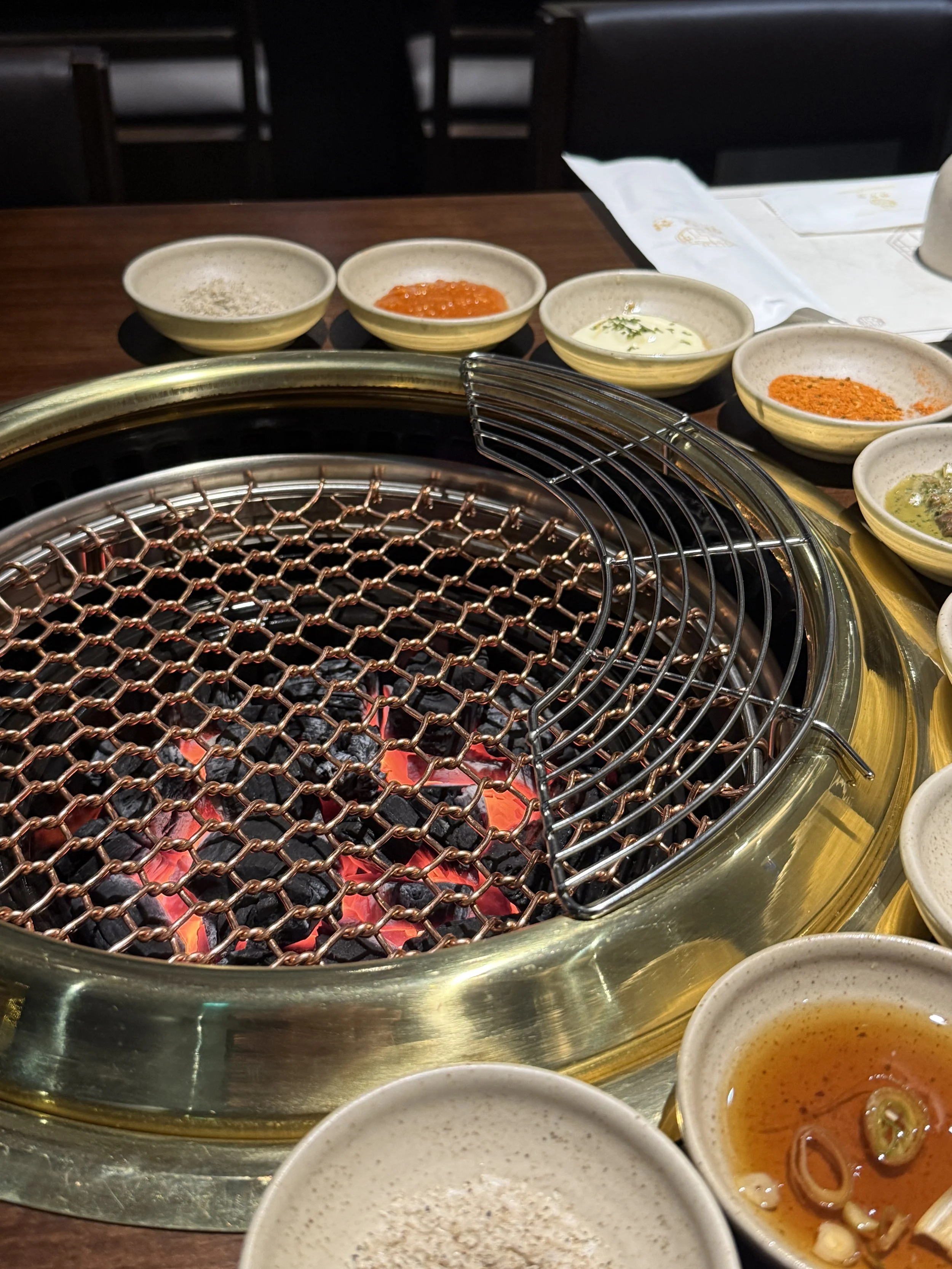
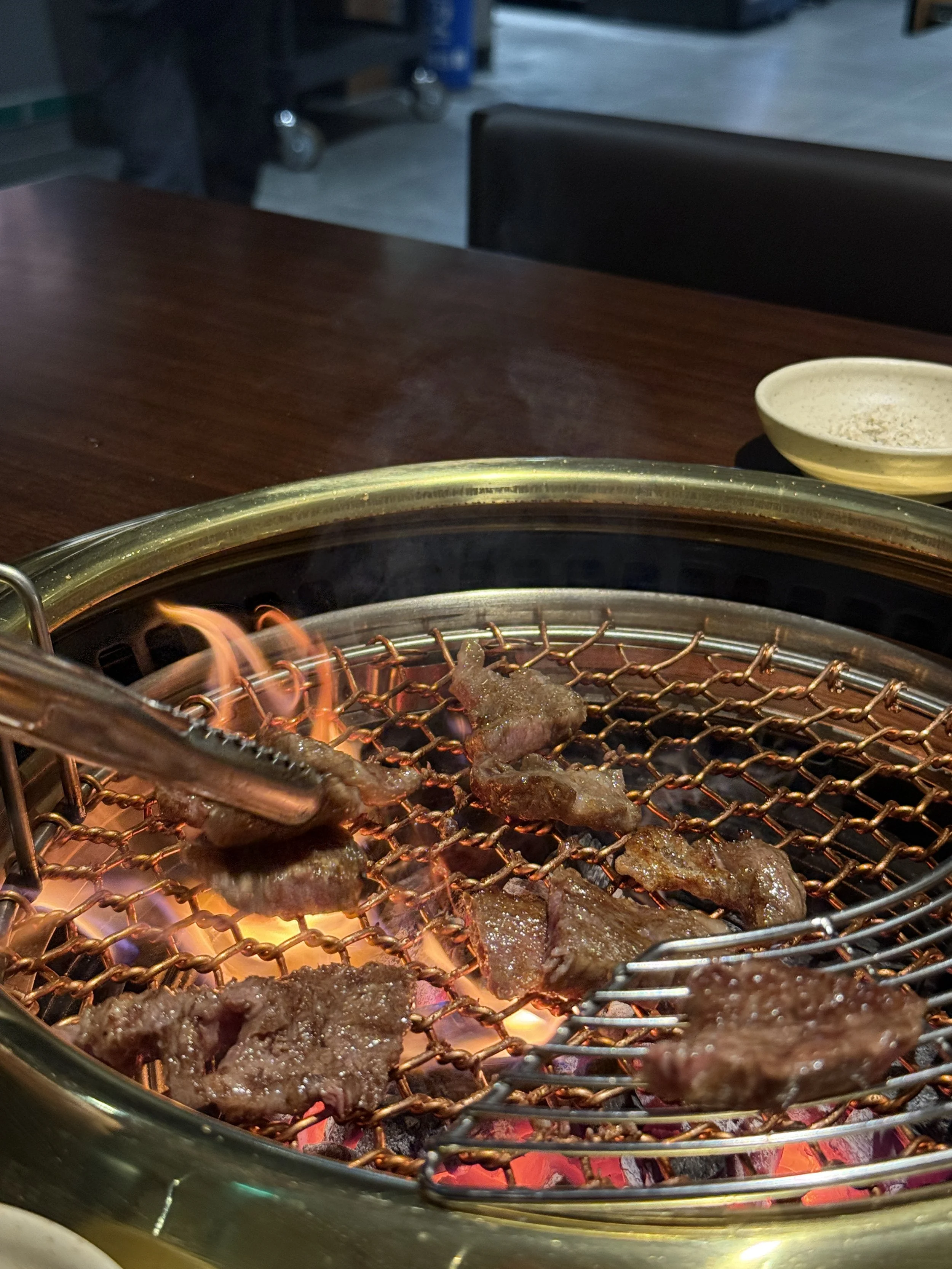
Hanwoojeong uses real charcoal at the table.
That is important.
There is nothing inherently wrong with gas grills, and many excellent Korean barbecue restaurants use them. However, charcoal contributes something different to premium beef.
Once the charcoal was brought to temperature and the grill placed over it, the table immediately developed the unmistakable aroma of Korean charcoal barbecue.
As the Hanwoo fat began to render and drip toward the heat, occasional flames rose through the grill.
Those short bursts of flame created a light char on the exterior of the beef without dominating the natural flavor of the meat.
With premium Hanwoo, restraint is important. You do not want the flavor of smoke to overpower the beef itself.
The charcoal here worked more like a background seasoning.
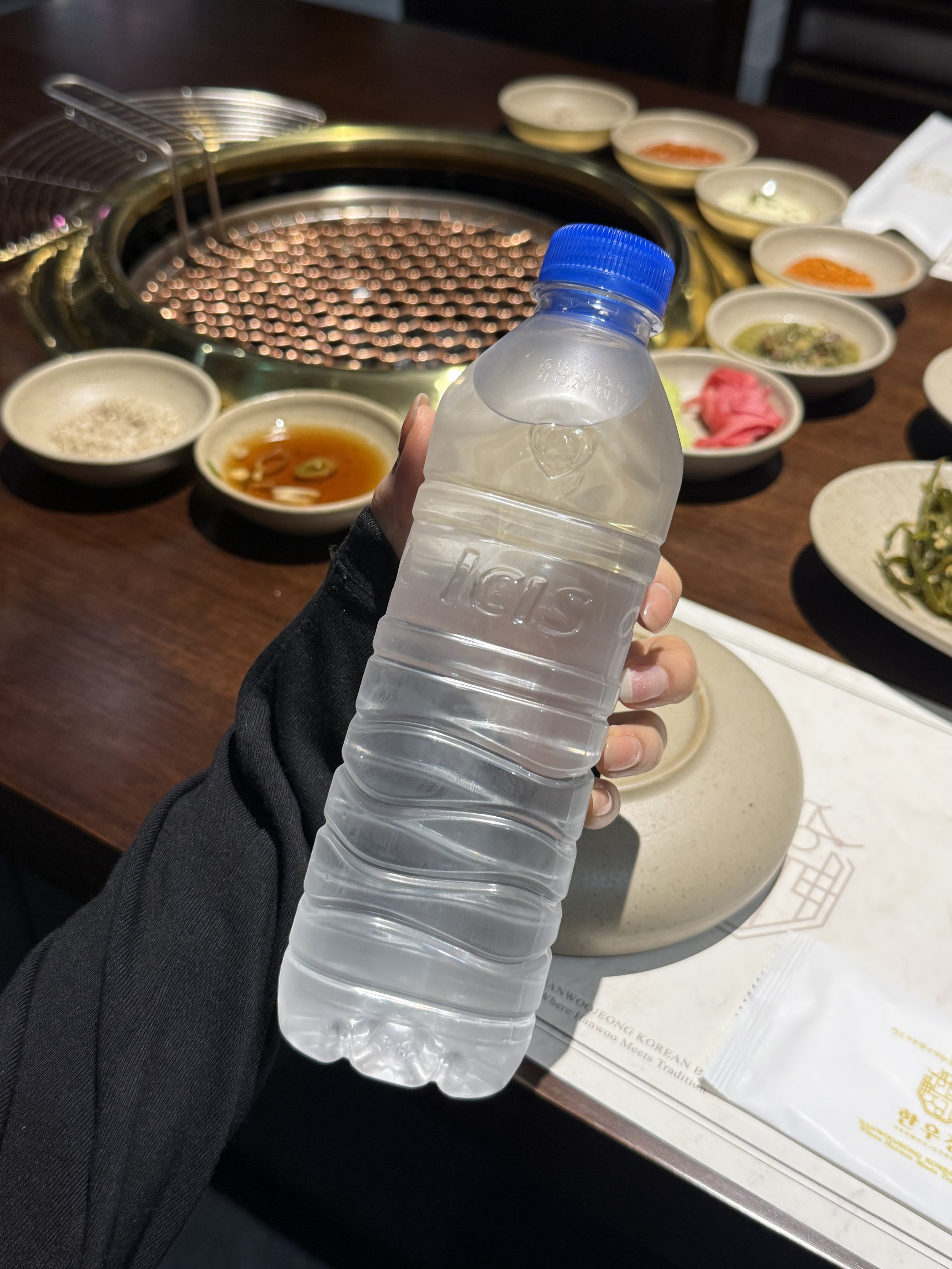
Bottled Water Is Served Individually
A small service detail I appreciated was the bottled water.
Rather than providing a communal pitcher, each diner receives an individual bottle.
It sounds minor, but this is the kind of detail that contributes to the restaurant's more polished positioning.
For international visitors in particular, individual bottled water also removes the awkward question of whether table water is filtered or where it has come from.
It simply arrives at the table and is part of the setup.
The Hanok Meat Platter Is One of the Restaurant's Most Distinctive Details
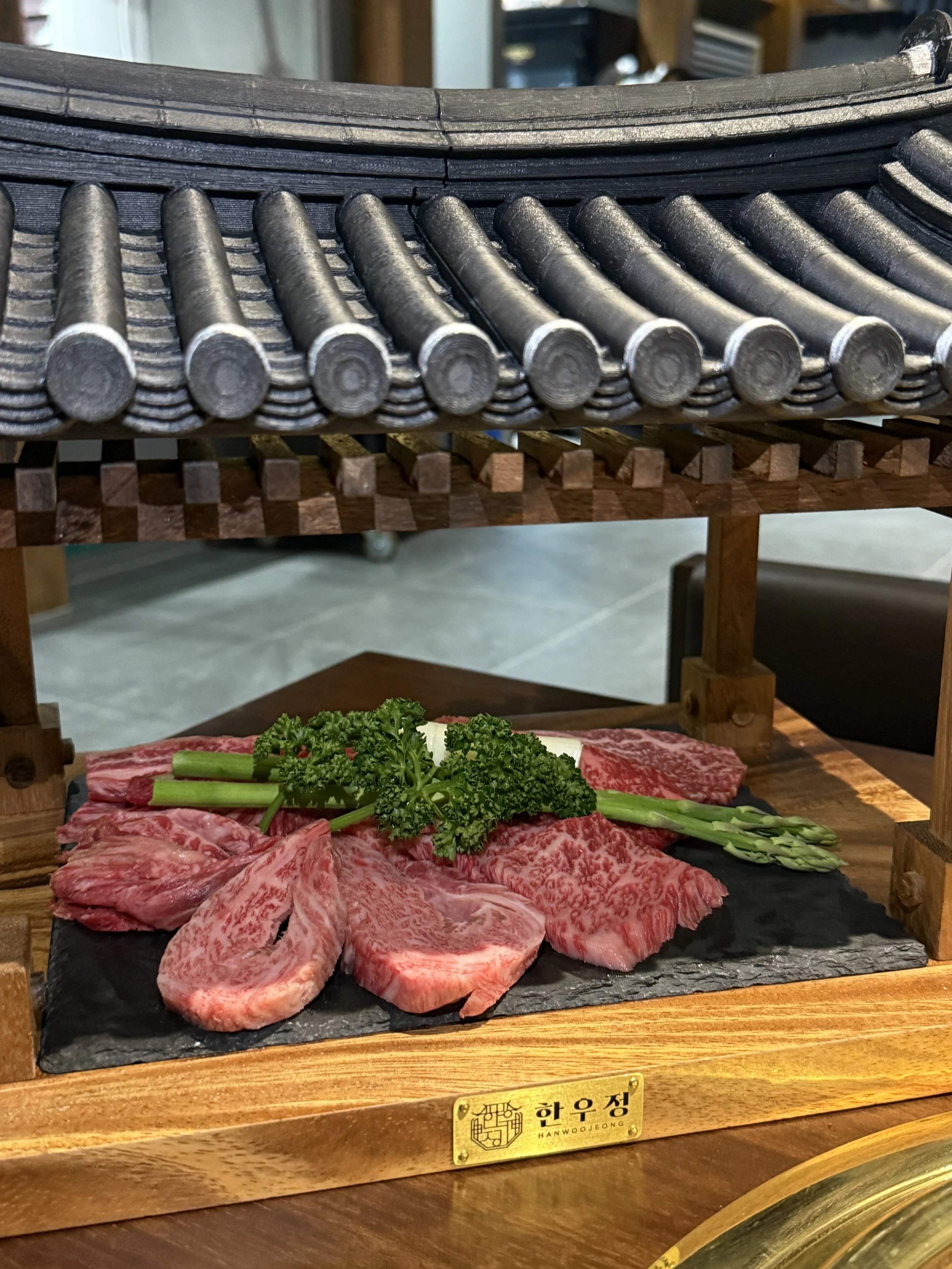
The presentation of the raw beef was easily one of the most memorable parts of the meal.
Instead of a standard ceramic plate or wooden board, our Hanwoo arrived on a specially designed structure inspired by the curved roof of a traditional Korean hanok.
The beef sits underneath the tiled roof structure on a dark presentation board, with the Hanwoojeong name displayed at the front.
I have eaten Korean barbecue in many different formats, but I had not previously seen premium Hanwoo presented this way.
It could easily have become gimmicky, but because the rest of the restaurant already incorporates Korean architectural elements, the presentation actually feels consistent with the concept.
More importantly, it creates a strong sense of occasion when the meat arrives.
For travelers celebrating a birthday, anniversary or simply having one special dinner during a Seoul trip, those visual details make the experience much more memorable.
Staff Grill the Hanwoo for You
One of the biggest advantages for international visitors is that the staff handle the grilling.
This is especially useful with expensive Hanwoo.
Cooking highly marbled beef is not difficult, but there is a relatively narrow window between rendering enough fat to bring out the flavor and leaving the meat on the grill long enough to lose its tenderness.
At Hanwoojeong, the staff controlled that process for us.
Different cuts were placed on the grill in stages, turned carefully and removed once they reached the intended doneness.
Watching the process also made it much easier to understand how the restaurant expected each cut to be eaten.
This is not the kind of barbecue experience where a tray of raw meat is delivered and the staff disappear.
The service is part of the product.
Multilingual Explanations Make It Accessible to Travelers
Another surprisingly useful feature was the pairing explanation.
Staff did not simply place cooked meat in front of us. They explained how particular pieces could be eaten with different sauces and accompaniments.
During our visit, explanations were available in Korean, English and Chinese.
For a restaurant in Myeongdong, this makes a lot of sense.
Korean barbecue etiquette is not particularly complicated, but premium Hanwoo introduces questions that travelers may not know to ask.
Which sauce works with which cut?
Should the meat be eaten with salt first?
What is the purpose of the ginger?
Which accompaniment is intended to balance a fattier piece?
Being guided through those combinations made the meal considerably more interesting than simply eating several plates of beef.
The Hanwoo: Rich, Tender and Best Eaten Slowly
The most important question, of course, is whether the beef itself lives up to the presentation.
It did.
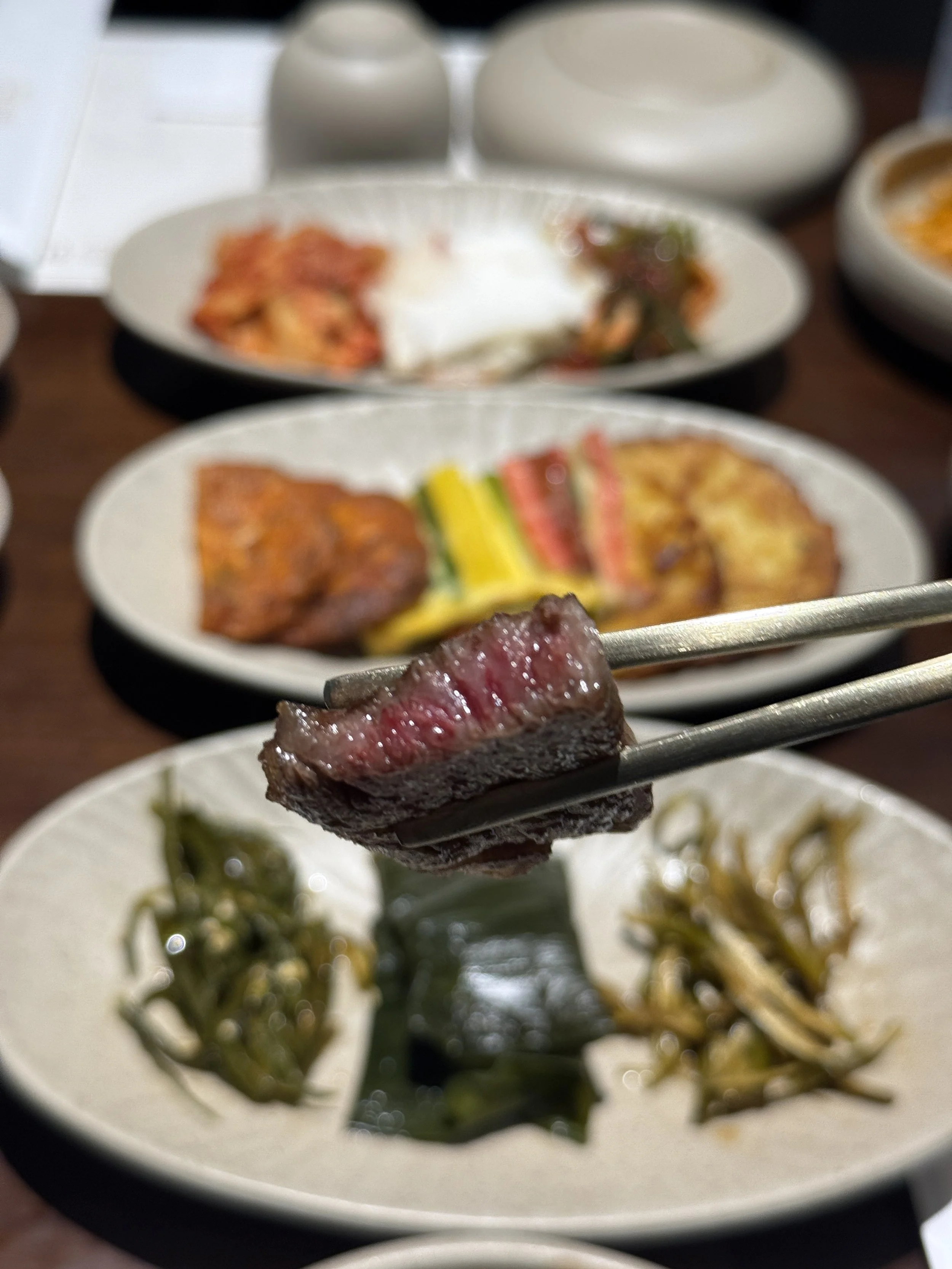
The meat had the unmistakable combination you want from premium Hanwoo: a soft texture, concentrated beef flavor and marbling that melted into the meat rather than remaining as chewy fat.
Some pieces were naturally richer than others, which made the progression of different cuts more interesting.
What impressed me most was the texture.
The meat remained tender without becoming soft to the point of losing structure. There was still enough bite to remind you that you were eating beef rather than simply rendered fat.
The best pieces developed a lightly caramelized exterior from the charcoal while remaining pink and extremely juicy through the center.
Eating the first few pieces with salt alone was probably the clearest way to appreciate the actual quality of the Hanwoo.
After that, experimenting with the various sauces made the meal much more dynamic.
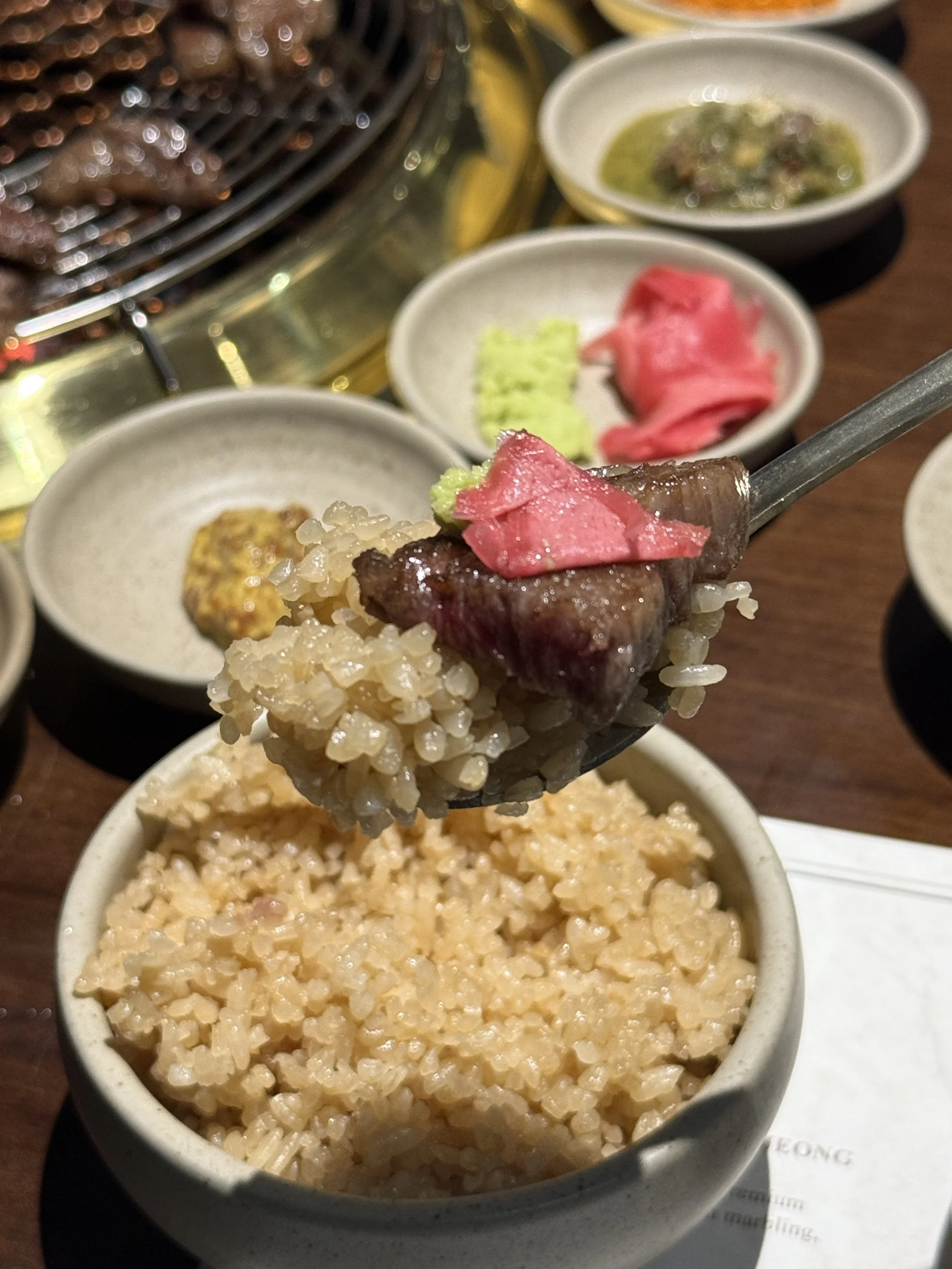
Wasabi, Ginger and Hanwoo Work Surprisingly Well Together
One of the combinations the staff encouraged us to try was Hanwoo with wasabi and pickled ginger.
Wasabi with premium beef has become increasingly common because its sharp heat cuts through heavy marbling without covering the meat in sweetness.
The ginger adds another layer of acidity and freshness.
Together, they create a much lighter bite than something like ssamjang or a thick barbecue sauce.
With richer pieces of Hanwoo, I found this combination especially effective.
It allowed us to continue eating without the richness becoming tiring halfway through the meal.
That balance is important during a multi-cut Hanwoo dinner.
The Signature Rice Was One of My Favorite Pairings
Another standout came when the staff paired grilled Hanwoo with the restaurant's rice.
A bowl arrived with beautifully glossy seasoned rice, which was topped with grilled beef, pickled ginger and a small amount of wasabi.
The combination sounds simple, but it was excellent.
The warmth and subtle seasoning of the rice absorbed the rendered fat from the Hanwoo, while the ginger and wasabi stopped the bite from becoming too heavy.
This ended up being one of my favorite ways to eat the meat.
The beef alone is obviously the centerpiece, but the rice transforms it from an individual piece of premium beef into a complete bite.
It is also a pairing I would recommend saving until after you have already tasted the Hanwoo by itself.
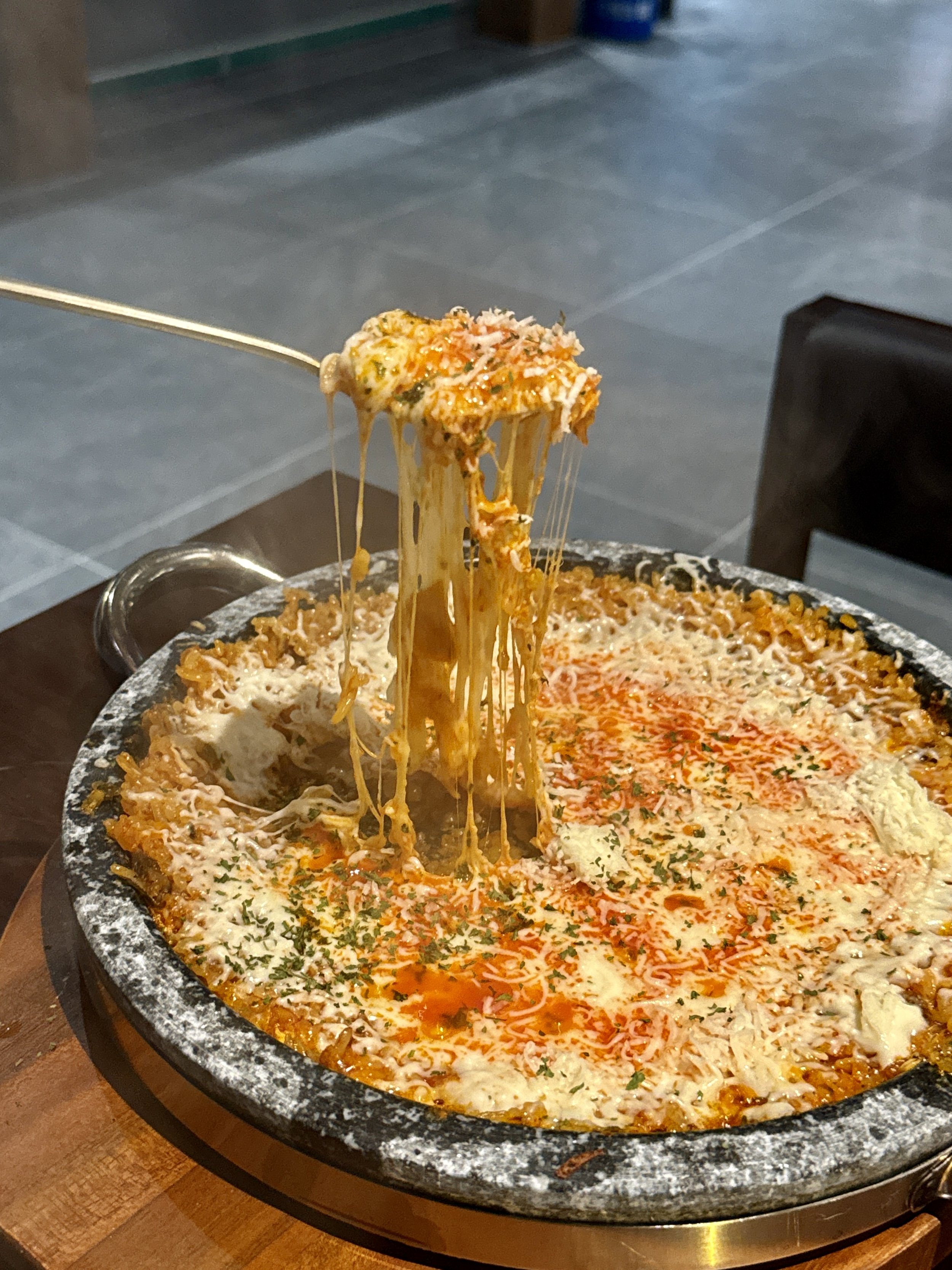
Short Rib Kimchi Fried Rice With Cheese Is the Side Dish I Would Order Again
Toward the later part of the meal, we tried the short rib kimchi fried rice.
This is not a restrained dish.
The fried rice arrives in a large hot pan and is generously covered with melted cheese.
When lifted from the pan, the cheese stretches dramatically from the rice, which makes it one of the most photogenic dishes on the table.
More importantly, it tastes good.
Kimchi fried rice needs enough acidity and spice to remain recognizable underneath toppings, and this version had enough seasoning to stand up to the cheese.
The short rib added richness and made it substantial enough to feel like a real final savory course rather than an afterthought.
After eating delicately grilled Hanwoo with salt and wasabi, finishing with hot, cheesy kimchi fried rice might sound excessive.
It is.
It is also very satisfying.
If I returned with a group, this is one of the dishes I would definitely order for the table.
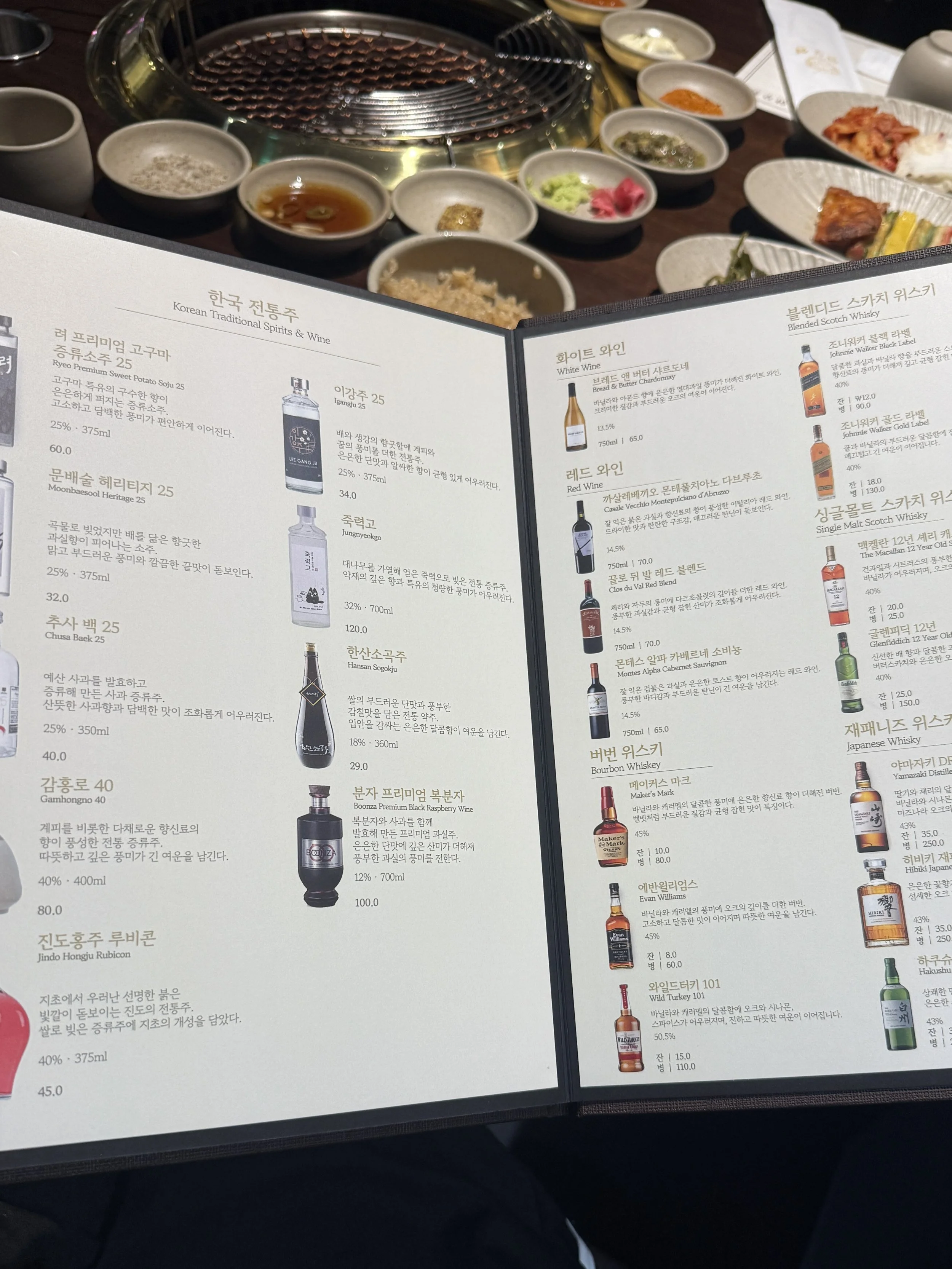
The Alcohol Selection Is Far More Extensive Than Expected
One area where Hanwoojeong is particularly unusual for a Korean barbecue restaurant is the beverage list.
This is not a place with three bottles of soju, two beers and a house wine.
The selection extends from traditional Korean spirits and fruit wines to wine, bourbon, blended Scotch, single malt whisky and Japanese whisky.
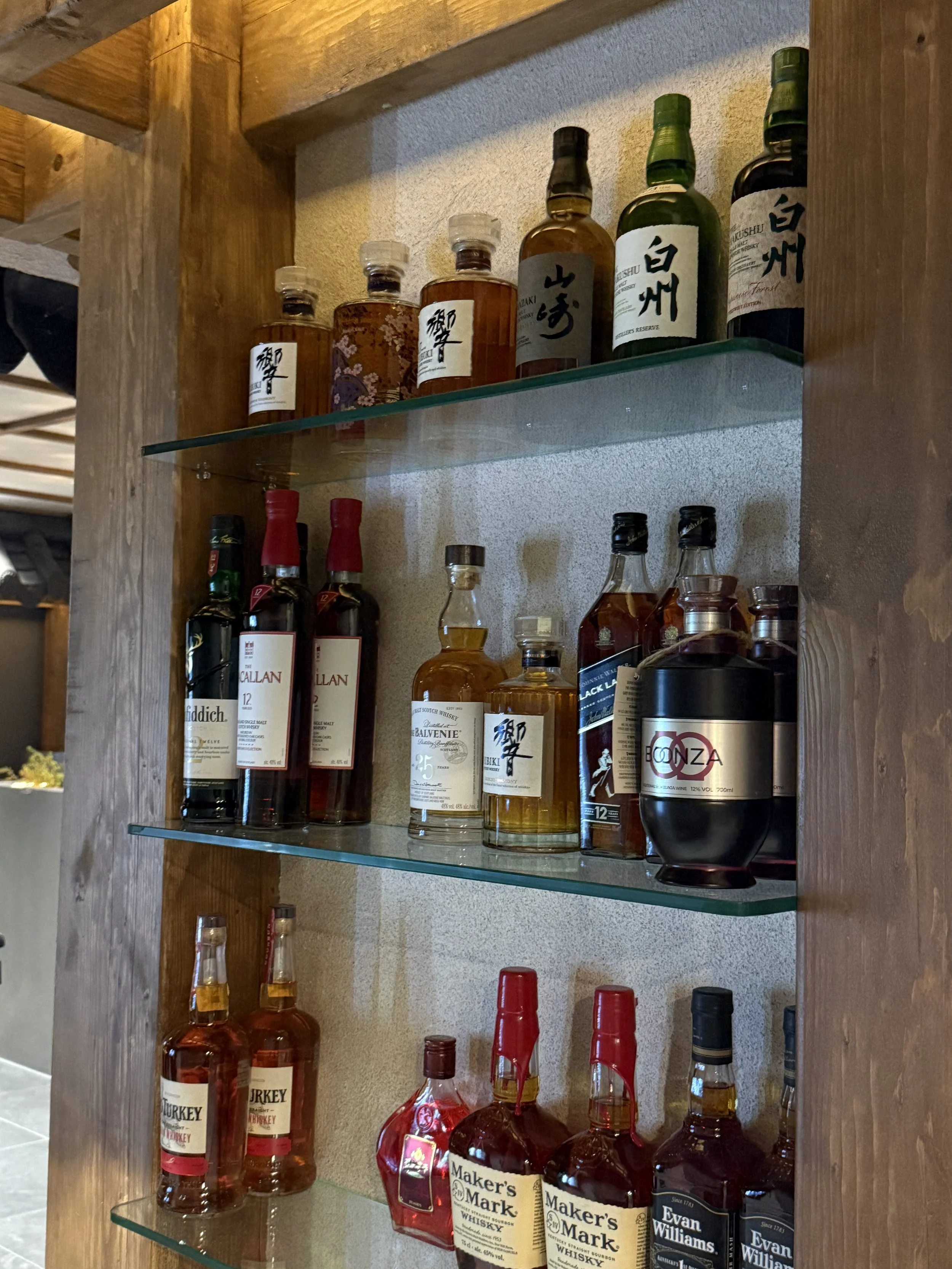
The physical display inside the restaurant makes the depth of the collection immediately obvious.
Bottles from major whisky houses sit alongside Korean traditional liquors and other spirits.
For travelers who are interested in alcohol, the Korean options are probably the most interesting place to begin.
The menu includes examples of traditional Korean drinks such as Igangju, Moonbaesool, Chusa Baek, Gamhongno, Jindo Hongju and Hansan Sogokju, among others.
Several of these are very different from the green-bottle soju international visitors normally associate with Korea.
Some are distilled spirits with considerably higher alcohol levels, while others are aromatic or fruit-driven drinks with long regional histories.
This gives diners an opportunity to turn a Hanwoo meal into something closer to a Korean food-and-drink tasting experience.
Whisky Drinkers Are Also Well Covered
If Korean traditional liquor is not your preference, the whisky selection is equally serious.
The shelves included recognizable names from Scotch, bourbon and Japanese whisky.
That breadth makes sense with heavily marbled beef.
Whisky and rich grilled meat can work extremely well together, particularly when the spirit has enough structure to stand up to the fat.
More importantly, it gives mixed groups options.
One person can explore Korean traditional alcohol while another orders wine or whisky without the restaurant feeling specialized exclusively around one drinking style.
For business dinners and special occasions, that flexibility is useful.
The Menu Is Designed for Different Levels of Commitment
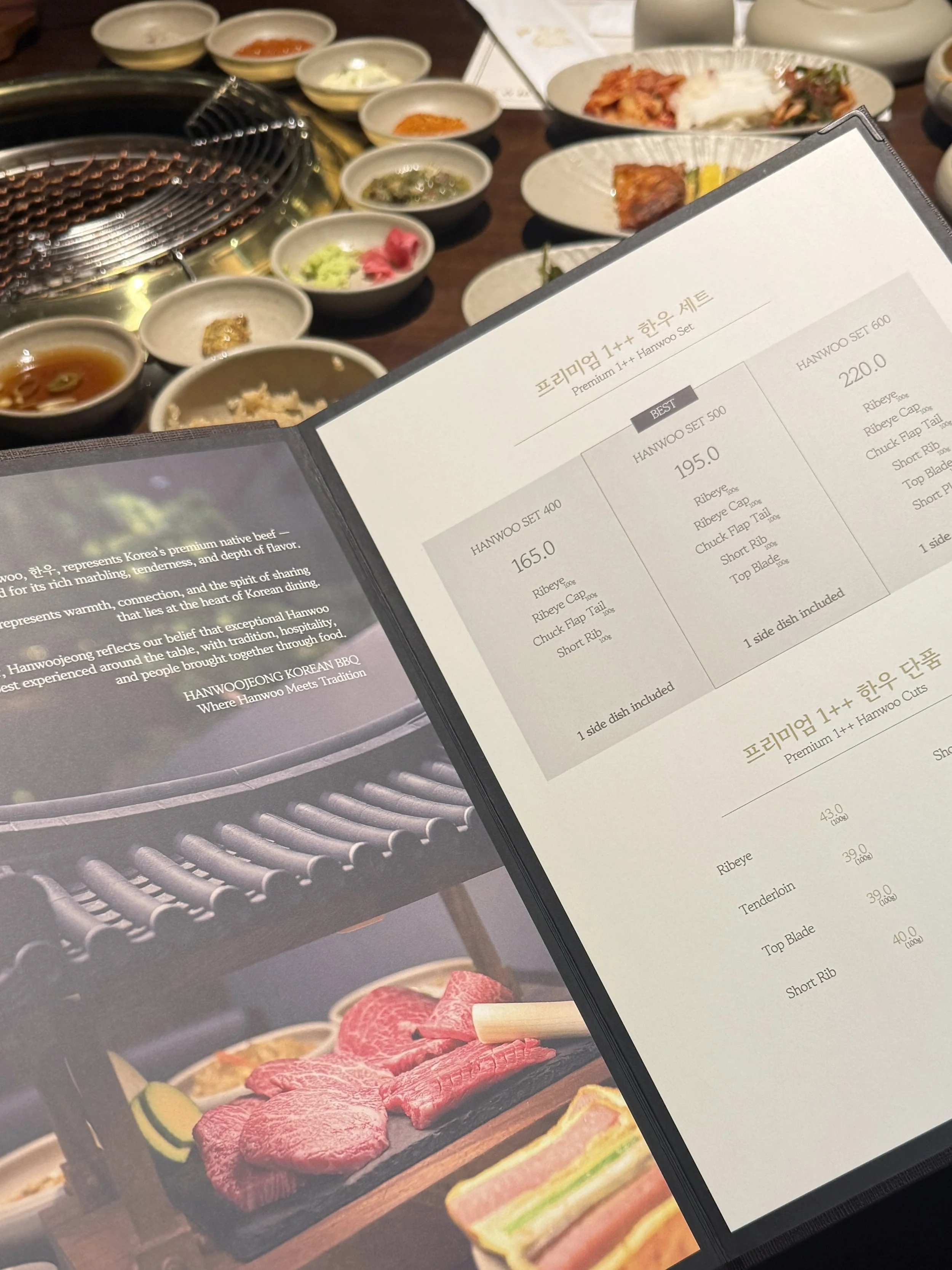
Hanwoojeong offers Hanwoo sets alongside individual cuts.
For first-time visitors, I would lean toward one of the set menus because it allows you to experience multiple cuts in a single meal rather than committing to one large portion of a single cut.
During our visit, the menu showed premium Hanwoo sets alongside individual cuts such as ribeye, tenderloin, top blade and short rib.
This structure works particularly well for international visitors who may understand “ribeye” but have less familiarity with the Korean terminology used for other cuts.
Trying several cuts side by side makes the differences easier to appreciate.
What Makes Hanwoojeong Different From Regular Korean BBQ?
The obvious answer is the beef grade, but that alone is not enough.
Plenty of restaurants in Seoul serve excellent Hanwoo.
What makes this particular experience different is the combination of several elements.
You have 1++ Korean beef, real charcoal, staff grilling, visible meat preparation, a hanok-inspired presentation, a serious collection of sauces and side dishes, multilingual service and a beverage program that goes well beyond basic Korean barbecue.
The restaurant also understands presentation.
The hanok meat platter, brass-colored grill surround, traditional tableware and interior all reinforce the Korean identity of the meal without making it feel old-fashioned.
For travelers, that matters because the meal feels specific to Seoul.
You could eat premium beef in almost any major city in the world.
This experience feels unmistakably Korean.
Is Hanwoojeong Worth Visiting?
If your priority is finding the cheapest possible Korean barbecue in Seoul, this is not the restaurant I would choose.
Hanwoojeong is clearly positioned as a premium Hanwoo experience.
You are paying for high-grade Korean beef, table-side grilling, a more elaborate service style, specialized presentation and a noticeably more developed beverage selection.
For travelers who only have one or two nights in Seoul and want one memorable Korean barbecue dinner, the value proposition makes much more sense.
I would particularly consider it for couples, families, business dinners or anyone celebrating an occasion while traveling.
The fact that staff handle the grilling and can explain the experience in multiple languages also makes it easier for first-time visitors who may otherwise feel uncertain at a premium Korean barbecue restaurant.
What I Would Order Again
If I returned to Hanwoojeong, I would build the meal around a mixed Hanwoo set rather than ordering only one cut.
I would start the beef with salt, then move to the wasabi-and-ginger pairing and try the chimichurri on some of the richer pieces.
I would absolutely order the potato jeon again, particularly with the truffle mayonnaise.
The signature rice with grilled Hanwoo was another combination I would repeat.
And unless the group was already completely full, I would finish with the short rib kimchi fried rice with cheese.
For drinks, first-time visitors to Korea should seriously consider choosing at least one traditional Korean alcohol rather than defaulting immediately to whisky or wine.
Final Thoughts on Hanwoojeong in Myeongdong
Hanwoojeong is not simply another Korean barbecue restaurant in Myeongdong.
The restaurant is clearly attempting to create a more complete introduction to premium Korean beef, and many of the details work because they reinforce the same idea rather than competing for attention.
The Hanwoo is visibly fresh and beautifully marbled. Seeing larger cuts being prepared inside the restaurant adds confidence to the quality of the meat before it reaches the table. Real charcoal creates the aroma and light char that premium Korean beef deserves, while having the staff grill each cut removes much of the uncertainty for visitors unfamiliar with Korean barbecue.
The extensive banchan selection makes the meal feel generous rather than overly formal. Japchae, kimchi, vegetables and several varieties of jeon give diners plenty to explore between pieces of beef.
Then there are the nine sauces.
Some are familiar, some are unexpected, and the best part is discovering that they are not necessarily limited to the meat. The truffle mayonnaise with potato jeon was one of the best combinations of the evening.
The visual side of the experience also deserves credit.
Serving premium Hanwoo beneath a miniature hanok-style roof gives the restaurant an identity that immediately distinguishes it from the endless wooden boards and ceramic platters used at other barbecue restaurants.
And while presentation can attract attention, it would mean very little if the food underneath it were mediocre.
Fortunately, the Hanwoo itself was the strongest part of the experience.
Tender, richly marbled and carefully cooked over charcoal, it delivered the deep flavor and soft texture that people expect when they decide to spend significantly more on Korean beef.
The signature rice, wasabi, ginger, chimichurri and other accompaniments gave us several different ways to experience the meat rather than repeating the same bite throughout the meal.
The beverage program adds another dimension entirely.
For someone interested in Korean food culture, being able to pair Hanwoo with regional Korean spirits is much more interesting than simply ordering another bottle of standard soju. At the same time, the wine and extensive whisky selection means the restaurant can accommodate diners who prefer more familiar pairings.
Myeongdong has no shortage of restaurants aimed at tourists.
Hanwoojeong feels different because it does not simplify the Korean barbecue experience for visitors. Instead, it makes a more sophisticated version of that experience easier to understand.
For travelers searching for 1++ Hanwoo in Seoul, premium Korean BBQ in Myeongdong, a special dinner in Seoul or a high-end Korean beef restaurant, Hanwoojeong is a restaurant worth putting on the shortlist.
